
TOWER CRANE
Tower Crane
Tower cranes play an important role in terms of speed and acceleration of work. All project operations are strongly influenced by the functioning of the tower crane, due to its dominant role in the smooth running of the project development. For project cost efficiency, it is necessary to estimate the schedule and time for the use of tower cranes prior to construction. In high-rise building projects, tower cranes are generally used for reinforcement work, casting work, formwork lifting, precast wall lifting, sand and electrical and mechanical units.
According to Rostiyanti (2008), tower crane is a tool used to lift material vertically and horizontally to a high place in limited space. Called a tower because it has a vertical frame with a standard shape and is plugged into a fixed position. The main function of the tower crane is to distribute the materials and equipment needed by the project both vertically and horizontally. Tower cranes are electromotor equipment, meaning they use electricity as a driving force. The motion power is obtained from PLN and generator sets.
The selection and placement of tower cranes must be as good as possible in order to be able to transport material to the maximum and reach the entire project area by using the length of the arm (jib length). The farther the radius of the jib, the lower the lifting ability. On the tower crane there are two limit switches:
- Maximum load switch: to monitor the cable and ensure there is no overload.
- Load moment switch: to ensure the operator does not exceed the ton-meter rating for the crane, when the load is moving on the jib. A tool called "cat head assembly" on the slewing unit, can detect early when there is an overload condition.
Tower Crane Type
The types of tower cranes are divided based on the way the crane stands, namely:
- Free Standing Crane
Free standing cranes (free standing cranes) stand on a foundation specially prepared for the tool. If the crane has to reach great heights, deep foundations such as piles are sometimes used. - Rail Mounted Crane
The use of rails on rail mounted cranes makes it easier for the tool to move along the rails. But in order to stay balanced the movement of the crane cannot be too fast. The disadvantage of this type of crane is that the rail price is too expensive, the rail must be placed on a flat surface so that the pole does not tilt. - Climbing Tower Crane
This crane is placed inside the building structure, namely on the core or the core of the building. This crane moves up as the structure rises. Lifting of the crane is possible with hydraulic jacks. With limited land, the alternative use of climbing cranes. - Tied In Crane
This type of crane is able to stand freely at a height of less than 100 meters. If a crane with a height of 100 meters is required, the crane must be tethered or anchored to the building structure to withstand horizontal forces.
Tower Crane Parts
Take a look at the detailed picture of the Tower Crane below:
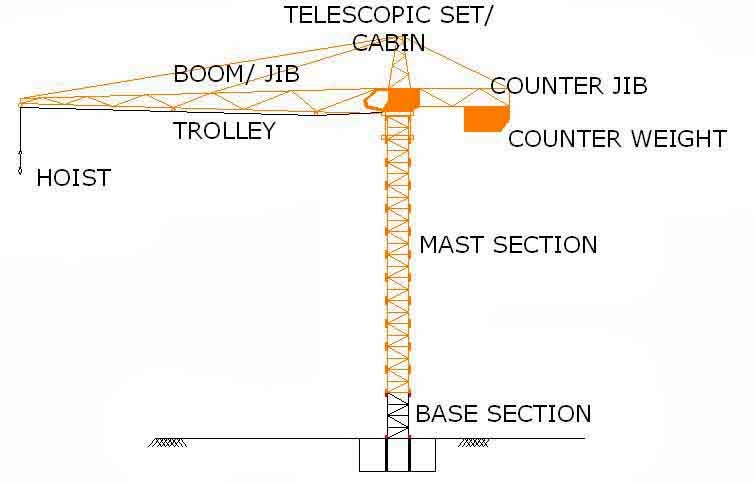
Image 1. Tower Crane Details
1. Base Section
The most basic part / segment of the tower crane body that is directly attached to the foundation. Look at the picture below:

Image 2. Base Section
2. Mast Section
Part of the tower crane body in the form of a frame segment that is installed to increase the height of the tower crane.

Image 3. Mast Section
3. Cat Head/Tower Top
The top of the tower crane that functions as a support for the jib and counter jib retaining cables. Look at the picture below:

Image 3. Cat Head/Tower Top
4. Slewing Machine/Slewing Ring
The mast, which rotates 360 degrees, plays a role in the swivel mechanism. Look at the picture below:

Image 4. Slewing Machine
5. Jib
Load carrying arms with various lengths depending on needs. Look at the picture below:

Image 5. Jib
6. Counter Jib
Balance arm against jib moment load. Look at the picture below:

Image 6. Counter Jib
7. Cabin Set
Tower crane control operator station. Look at the picture below:

Image 7. Cabin Set
8. Climbing Frame
Part of the tower crane that functions as a support when adding mast.
9. Support Frame
Is a position / pedestal that supports the slewing ring in the swivel mechanism, consisting of the upper (upper) and lower (lower).
10. Slewing Mast
The mast, which rotates with the jib, is located under the cat head.
11. Counter Weight
The concrete block which is the ballast, which is forced on the end of the counter jib.
12. Access Ladder
The vertical ladder that serves as access for the operator to the cabin set is located inside the mast section.
13. Trolley
Tool for carrying the hook so that it can move horizontally along the jib.
14. Hook
Trolley-mounted load hook
15. Tie rope
Is a wire that serves to hold the jib so that it remains in a straight condition 90º to the main pole.
Tower Crane Selection Basis
The basis for selecting a tower crane consists of:
- Tower crane height
the height of the tower crane is adjusted to the height of the building to be served. High under hook (HUH) is determined by the maximum height of the building plus 2-4 meters for spelling when lifting materials. - Working arm or working radius (middle jib)
The working arm (jib length) is determined by the maximum distance of the material to be lifted later from the tower crane axle. - Tower crane capacity
The maximum load to be lifted at a certain point distance. - Static or Traveling
This depends on the planned use of the tower crane, if the service being served is not too high and the tower crane is still within the free standing limit, the tower crane is still brave to run. This is suitable when tower cranes are used to serve relatively elongated buildings.
Implementation Method
The use of tower cranes involves the process of:
- Mobilization is the process of moving/transporting tower crane components from the pool to the project site.
- Erection, is the process of assembling the basic components of a tower crane.
- Operational
- Dismantling, is the process of dismantling / releasing tower crane components so that demobilization can be carried out.
- Demobilization, is the process of moving / lifting tower crane components from the project site to the pool.
Use of Tower Crane
The amount of load that can be lifted by the tower crane has been regulated and obtained in the tower crane operation manual issued by the tower crane manufacturer. The principle in determining the load that can be lifted is based on the moment principle, so at a certain distance and height the tower crane has a limiting moment that should not be crossed. The length of the load arm and the load carrying capacity is a linear ratio. The product of the arm length and the maximum lifting power at each point is the same and shows the moment capability that can be accepted by the tower crane.
Tower cranes are used to transport building construction materials from the bottom to the part above, are also used to transport concrete bucket materials in the casting process and are able to lift various types of tools and materials to make column formwork, concrete iron, and so on. The way the tower crane works is divided into three movements, namely:
- Lifting and descending vertical movement (Hoist): The movement of lifting and lowering the load is regulated by the work of the driving motor which functions to roll the steel rope. This steel rope will move the load that is hung by the hook (hook) which will move up and down. When the position is in accordance with the desired then the movement will be stopped by the operator by pulling the lever (handle) connected to the brake.
- Horizontal Movement (Trolley): This movement is a trolley movement that runs / moves in a horizontal (horizontal) or transverse direction. This movement is controlled by a motor that functions as a trolley running along the rails located above the girder and boom.
- Swing Movement: This movement occurs due to the rotation of the motor that rotates the jib gear so that the jib can rotate to the right or left at an angle of 360º.
Equipment Operational Cost (Operational Cost)
Operating costs are costs related to the operation of an equipment, where these operating costs occur only when the equipment is used (Nunnaly, 2007). Operational costs consist of:
- Equipment Operator Costs This cost is the cost for human resources operating the equipment (Day, 1973).
- Equipment Mobilization and Demobilization Costs These costs are costs incurred to transport equipment between the project and the equipment storage area.
- Erection-Dismantle Cost This cost is the cost incurred for the installation and dismantling of the tower crane used in the project.
- Lubricating Costs The amount of lubricating oil used by an engine will vary with engine size, piston ring condition, and oil change intervals. Generally, oil changes are carried out every 100 to 200 hours.
- Fuel Cost The amount of fuel for heavy equipment that uses gasoline or diesel varies. On average, equipment that uses gasoline is 0.06 gallons per horse-power per hour, while equipment that uses diesel fuel consumes 0.04 gallons of fuel per horse-power per hour.
- Electricity Cost This cost is the cost incurred by the contractor if the electricity source used in the project comes from PLN.
